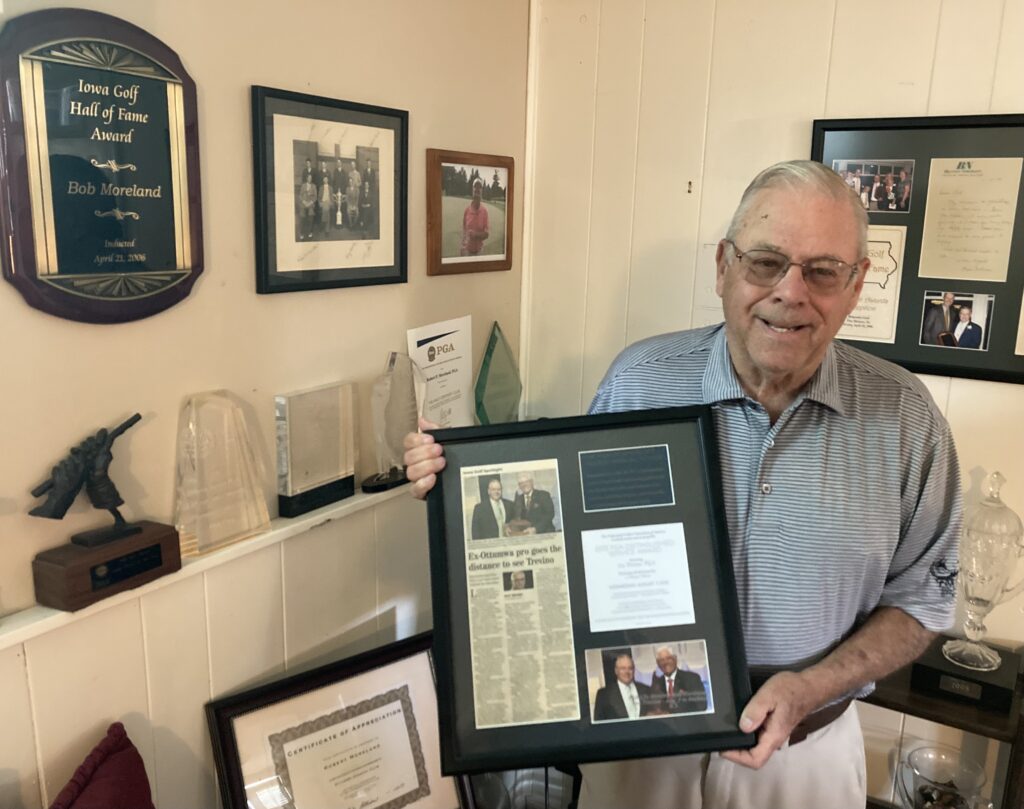
Bob Moreland poses in his den that features memorabilia of golf achievements and honors that stretches more than five decades.
Moreland Reflects on his Extraordinary Club Pro, Playing Career
Bob Moreland was predestined to become a golfer. But the retired, long-time Ottumwa Country Club professional admits fishing was his first love.
Growing up in Peoria, IL., Moreland would much rather hit the fishing hole than the golf course. It wasn’t until the age of 13 that his deep golf roots prevailed, when he replaced casting a reel with rifling a 5-iron.
“I actually didn’t start playing until the seventh grade and then really made up for lost time. Day after day, Mom would drop me off at the course at 8:00 a.m. and come pick me up an hour after dark,” recalled Moreland, the well-decorated Iowa Section PGA golf professional and Iowa Golf Hall of Fame member, during a recent interview at his home in Ottumwa. “She would give me a dollar for the day for a hot dog and a Coke. We’d play 36 holes and then putt for dimes underneath the streetlight. On a good day, I’d return home with more than a buck.”
Moreland’s golf pedigree is extraordinary. His father, Gus Moreland was a world-class player in the 1930s. Competing as an amateur, Gus Moreland beat the likes of Ben Hogan in the Southwestern Amateur, Byron Nelson in the Glen Garden Invitational, Johnny Goodman in the Houston Invitational, Lawson Little in the Trans-Mississippi, and Francis Ouimet in an early round of the British Amateur. He played in the inaugural Masters Tournament in 1934 and was a two-time selection for The Walker Cup, where he never lost a match in singles or doubles competition.
“Dad and Ben Hogan were friends and competitors, he’s mentioned in the book Hogan, written by Curt Sampson,” said Moreland. I remember going to Shady Oaks Country Club in Dallas to watch Hogan hit 120-yard wedge shots on the range. He’d take aim at his caddie, who was armed with just a towel, and the caddie only had to move slightly in either direction to shag those balls.”
Gus Moreland eventually turned professional at the age of 53, taking a club job in Pampa, TX, and later in Peoria, IL., where Bob Moreland grew up and would eventually lead Richwoods High School to the Illinois state championship. That performance was a springboard to a successful golf career in its own right. Moreland moved to Texas right after high school in 1962 to seek his golf fortune, going to work at Cedar Crest Golf Course in Dallas, site of Walter Hagen’s fifth and final PGA Championship.
“One day in 1963, the head pro said there’s this Mexican guy who can play a little bit, and you should meet him. He paired us together, and I found out rather quickly how well he could play. That guy was Lee Trevino,” Moreland said.
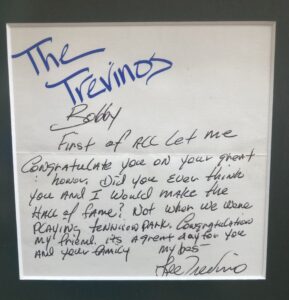
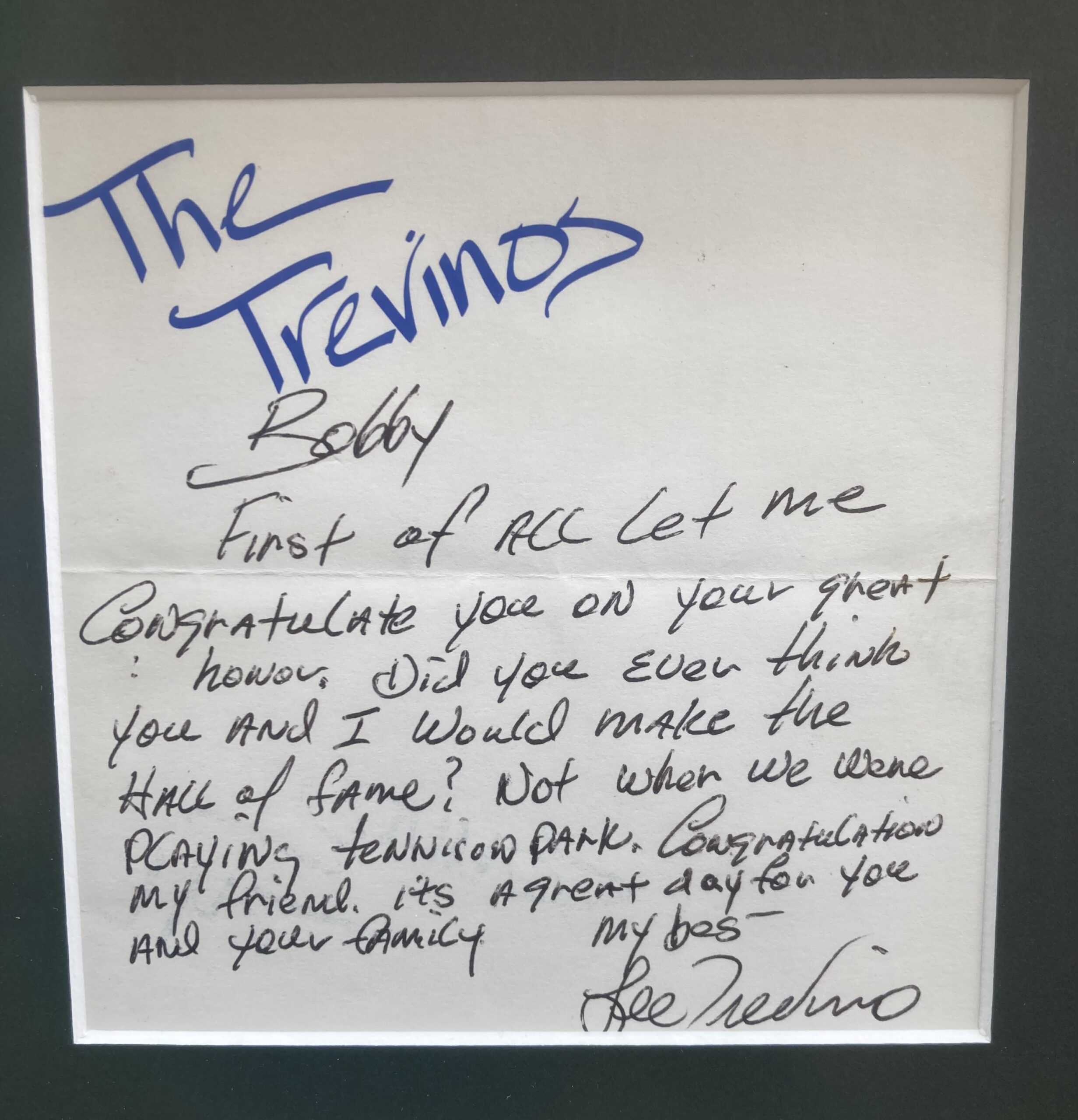
Moreland received a hand written note of congratulations from golf legend Lee Trevino upon his induction into the Iowa Golf Association Hall of Fame. Moreland met Trevino in Dallas in 1963 and maintains a close friendship to this day.
Moreland and Trevino were frequent golf companions for the next few years until Trevino burst onto the PGA Tour scene in 1967 by finishing fifth in the U.S. Open at Baltusrol. He came back to Cedar Crest and told Moreland, “I can beat these guys.” A year later, Trevino won the first of his six major titles, the 1968 U.S. Open at Oak Hill in Rochester, NY. They remain good friends.
In 1968, Moreland played the PGA Tour. In those days, fewer players had exempt status, resulting in large Monday qualifiers where, in some weeks, 150 players teed it up for 30 openings in the field. “It wasn’t a very glamorous lifestyle for the also-rans,” Moreland remembers. “We traveled by car, stayed in cheap motels, and scraped by.” He stepped away from the tour and held club professional positions in Texas and at Sunset Hills Golf Course in Pekin, IL, until his life changed in 1976.
That’s when the Ottumwa Country Club came calling, and Moreland would spend the next 34 years serving the club with distinction, not only in club operations and starting one of the state’s most successful junior golf programs but also maintaining a high level of playing ability, competing in Iowa PGA Section and national events. For a remarkable 17 times, Moreland was named the Iowa Section PGA Player of the Year in three categories: five in the regular category, ten times as Senior Player of the Year, and twice as Super Senior. He won the 1981 Iowa Open and was a two-time Iowa Section PGA champion.
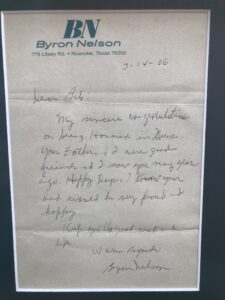
Byron Nelson also extended his personal congratulations to Moreland on his Iowa Golf Hall of Fame selection.
Strong performances in the annual PGA Club Pro Championship earned Moreland a spot in three PGA Championships: the 1977 event at Pebble Beach, the 1981 tournament at Atlanta Athletic Club, and the 1982 event at Southern Hills. He also qualified for and participated in the US Senior Open and several Senior PGA Championships. His extensive list of other golf achievements included playing several times in the former Quad Cities Open and making the cut in the 1973 Western Open in Chicago. In his prime, Moreland would play 18-20 section events annually. “In those days, club pros would play every Monday from the first of May until the end of September,” he recalled.
His playing accomplishments aside, Moreland is equally proud of the robust junior golf program he and his wife, Lynda, operated each year at Ottumwa Country Club. Between 85 and 120 boys and girls participated in a six-week program annually that featured instruction, rules and etiquette sessions, practice, and culminated with a tournament and awards banquet. Both the Ottumwa boys and girls high school golf teams would later capture multiple state championships populated with players from his program, and several would go on to become club professionals. His advice to young players today – “Get some good instruction, work on your short game, and leave the golf carts in the stall. Walking builds the endurance you need to become a good golfer. I see too many youngsters on carts.”
Among his other awards, Moreland was named the Iowa PGA Section’s Professional of the Year, Junior Golf Leader Award, and Merchandiser of the Year. The job of a club professional is demanding, juggling the daily tee sheet, running tournaments and leagues, conducting lessons, the pro shop, administration, and a multitude of other responsibilities. “I can honestly say that a day didn’t go by when I didn’t look forward to going to work,” Moreland said. “There were many long days during the golf season, which goes with the territory. It’s like joining the Mafia, you know exactly what you are getting into.”
Now 79 years old, Moreland looks back on his golf career with pride. “I’ve been so fortunate to work in a profession where you get to meet so many good people,” he said. “You can’t give up in the game of life or the game of golf. It’s a game you can play until they bury you.”
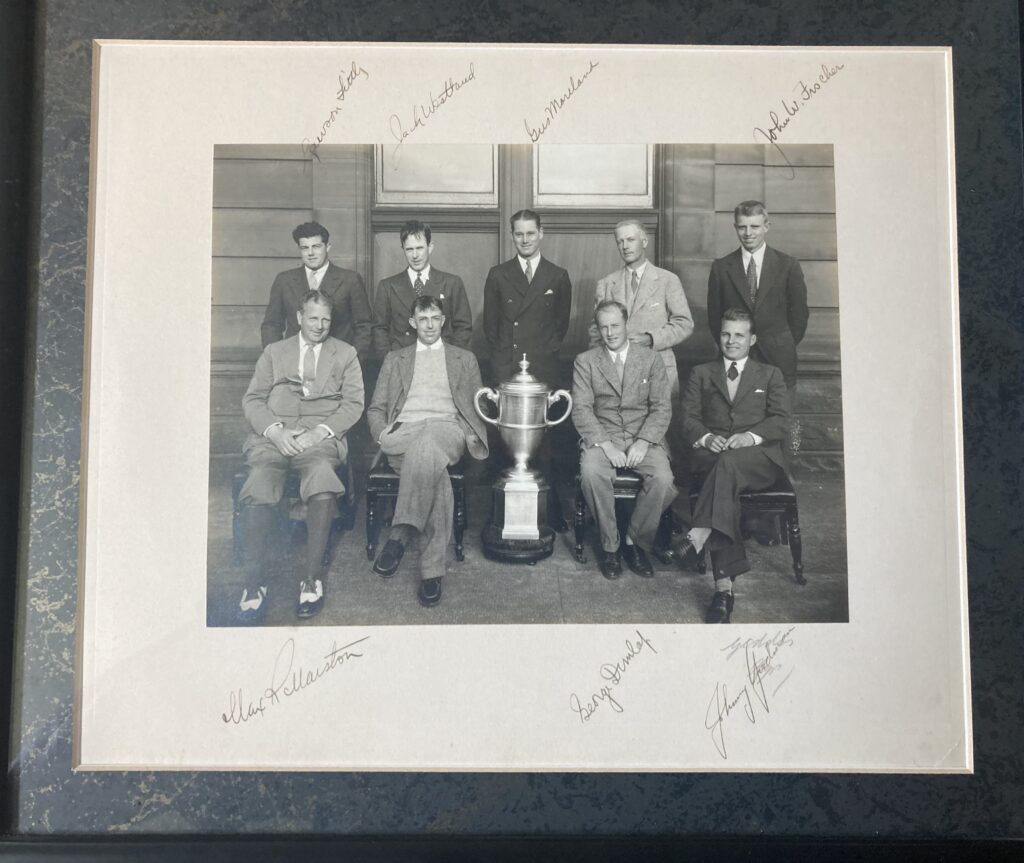
Bob Moreland’s father, Gus, (back row, center) is pictured with his 1934 Walker Cup teammates, including Lawson Little and Johnny Goodman and captained by Francis Ouimet. Gus Moreland also played in the 1934 Masters.
“Up and Down” the Iowa Golf Scene
 A regular feature column written by IGA Foundation board member Mark Gambaiana, Up and Down the Iowa Golf Scene is designed to take the reader beyond the headlines and scoreboards to share stories of those who help make Iowa golf so rich and rewarding. Profiles will spotlight those who advance the game through volunteerism, service, extraordinary achievement, competition, human interest and the many other dimensions of golf in Iowa.
Click the links below to read previous Up and Down features
– IGA Rules Official Sean Flanders
– R&A, USGA Champion Gene Elliott
– Nervig Reflects on Decades of Service to The Iowa Masters
– Arseneault Finds Fulfillment in Life’s Next Chapter After Competitive Golf
– Ivan Miller remembers the days of the Minnows
– Kinney adjusts to life on tour
– Standard Golf’s roots run deep
– Pettersen sets sights high
– McCoy, Norton Put Iowa Stamp on Florida Senior Golf


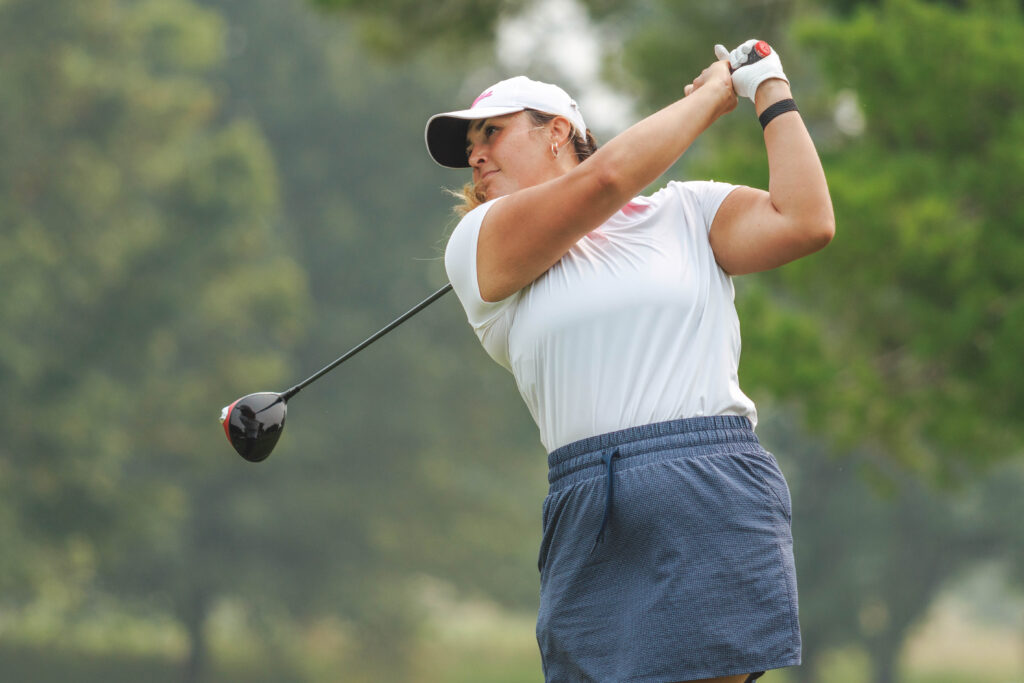
 In the Open Division, Des Moines’ Tish Boothe (right) keeps her position on top of the leaderboard at +19, but only holds a one-stroke lead over Waterloo’s Kelly Nelson. Nelson carded a (+8) 80 in her second round to climb into second at +20 on the tournament.
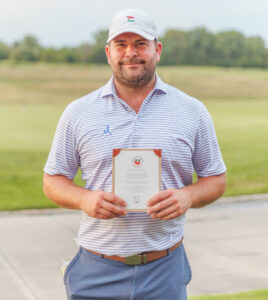 On the other hand, this was not Dennis Bull’s (right) first rodeo. Having qualified for the U.S. Amateur the previous two years, his experience showed when the second qualifying spot came down to a four person playoff. Ottumwa’s Cale Leonard, West Des Moines’ Braeden Nelson, and Clive’s Ryan Horner joined Bull in the four-for-one playoff, as if 36 holes wasn’t enough for the day. After Nelson and Horner were eliminated on the first playoff hole, Bull and Leonard tied on the second playoff hole, but Bull won decisively with a birdie on the third hole.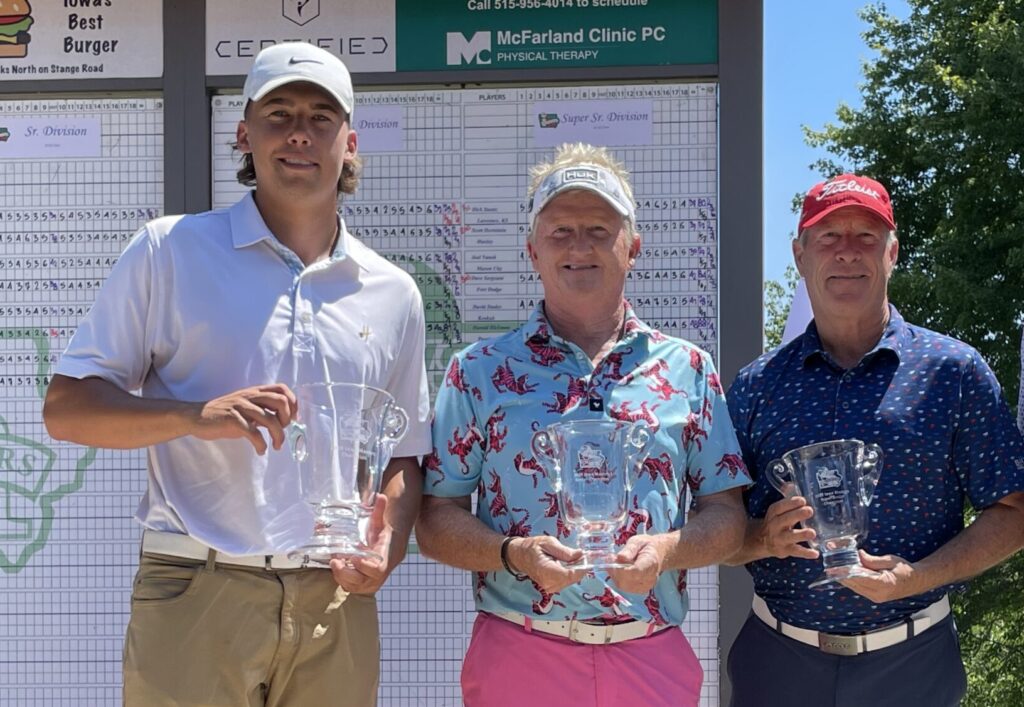
 Experience was the key for Cedar Falls’ Hannah Bermel (right) at the 12th IGA Match Play Championship. She used that to come out on top with a 3 & 2 victory in the finals against Paige Hoffman, of West Des Moines. Bermel defeated Anna Jensen, of Dubuque, in the semifinals to set up the showdown with Hoffman.
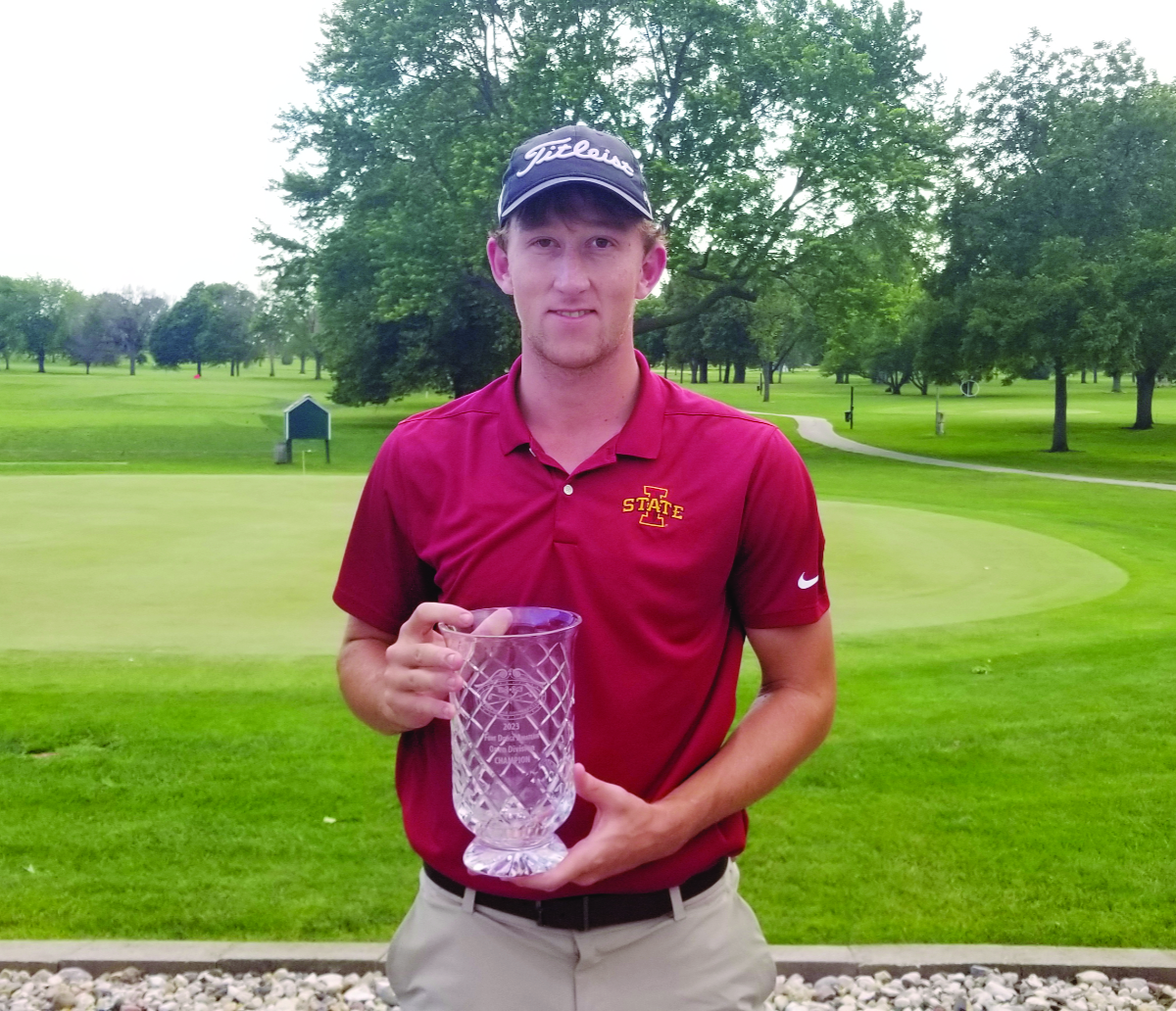
 Ames’ Zach May (right) made it look effortless for most of the time, but it was far from easy the Iowa State golfer said following his win in 21 holes over Ankeny’s Connor Peck to capture the 35th IGA Match Play Championship.
 McCoy will play Ames’ Zach May (right) in an Iowa State vs. Iowa State face off. May, a rising sophomore from New Zealand, will challenge one of ISU’s all-time greats in what should be an exciting match. May proved his stamina after besting New Sharon’s Trent Lindenman (19 holes) and Decorah’s Jay Fjelstul (3&2).
 Henson will face 4-seed West Des Moines’ Paige Hoffman, who defeated Chase Doland (3&2) and Leanne Smith (4&3). After a slow start in the morning, Hoffman cleaned up her game and will be dangerous as she looks to forward her momentum come Friday.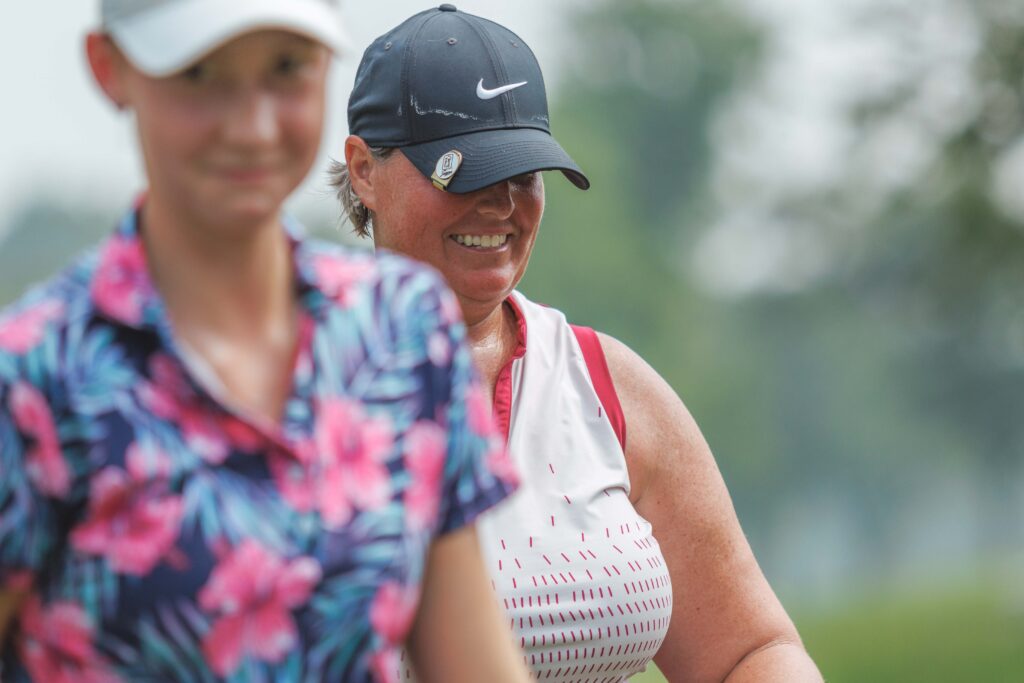
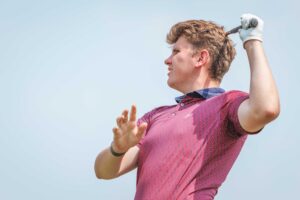 The day’s story belonged to the youth. Numerous high school, college, or recently graduated players populated the Round of 16, whose matches will be played tomorrow. The remaining spots belong to familiar veterans—Ankeny’s Nate McCoy, Ankeny’s Connor Peck, Norwalk’s Joe Palmer have all won this very championship before and will continue their pursuit of this year’s title.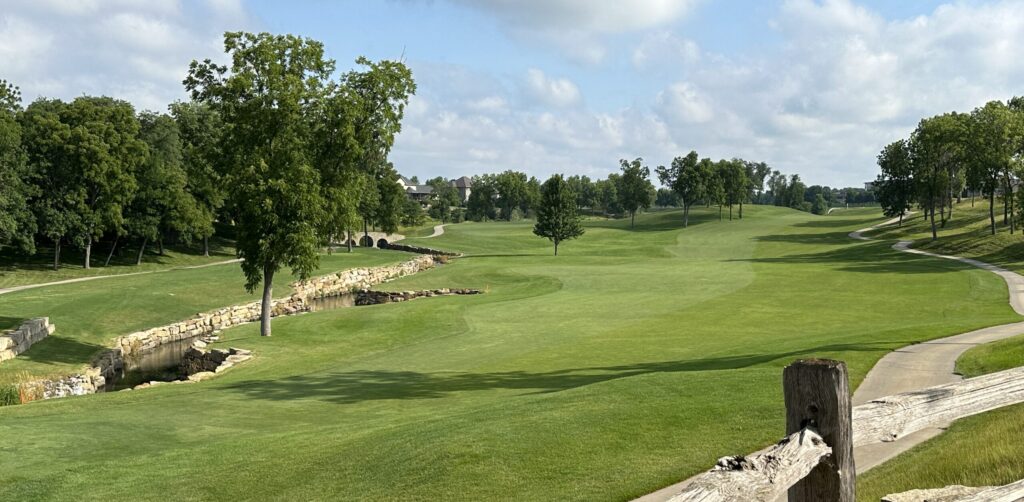
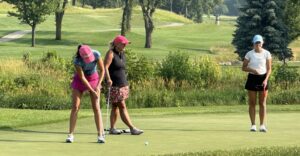 In the 12th IGA Women’s Match Play Championship, held concurrently at Talons Golf, Marshalltown’s Amber Henson earned the 1-seed with an even par 73. Six birdies and a strong back nine helped even out a difficult front nine with the putter.